

How to Talk To Robots Without Really Trying | My Guide to Killer AI Prompts & Even Better Results
My Lazy Girl Dinner Strategy for Stellar AI Prompts

Hello Everyone! It’s 9:30pm, and now that I have spent an entire day procrastinating on my newsletter, I think now is the best possible time for me to explain how I talk to robots.
Today, we’re going to be discussing AI prompting, AKA my top strategies for writing to AI chatbots to get the results you actually want that are ridiculously easy and effective.
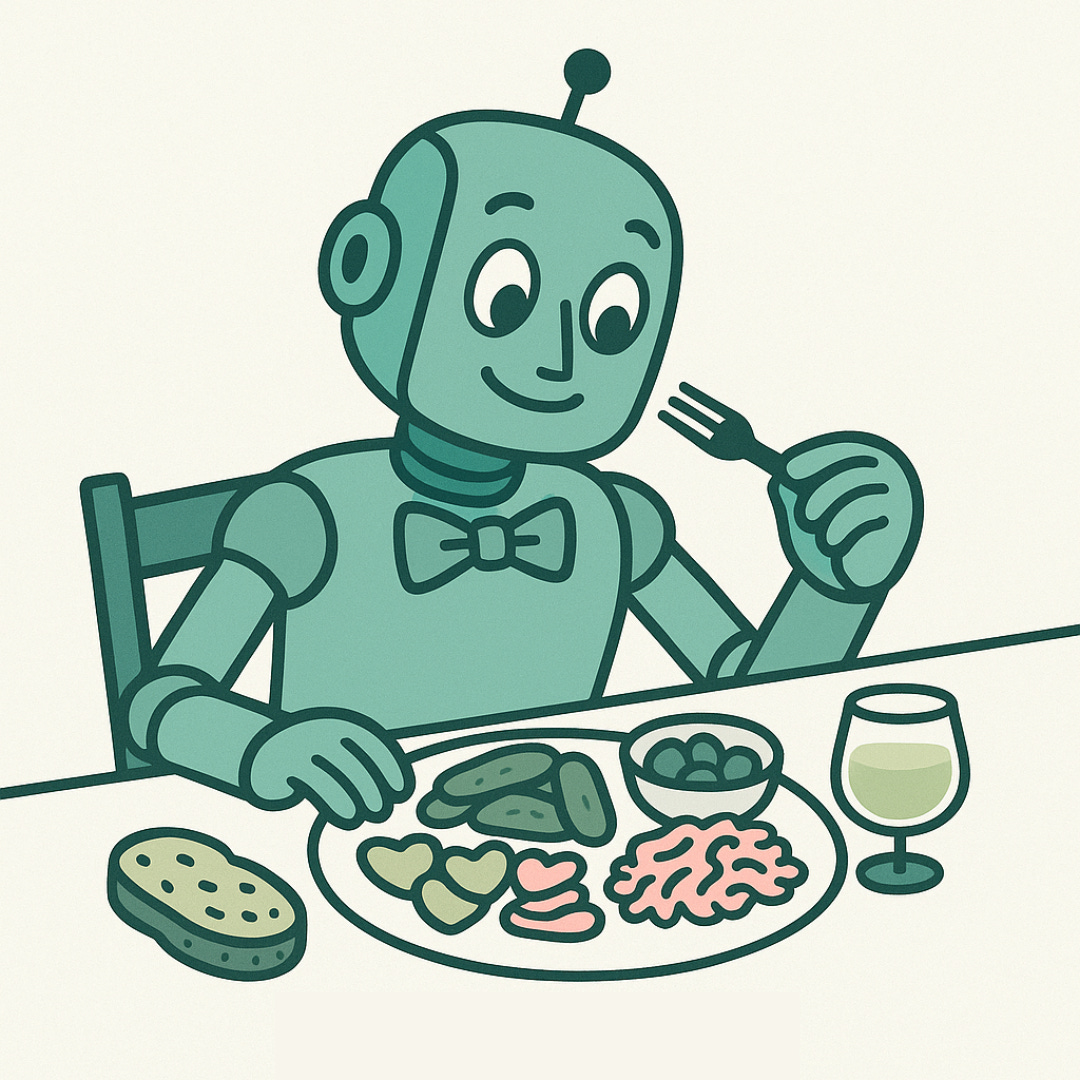
The Prompting Industrial Complex
Here’s the deal. I know there are a LOT of people who talk about how important AI prompting is and in some cases they’re right.
Prompting well helps reduce hallucinations, saves compute power (and yes, the planet), and gets you better answers the first time.
That said, I’m a wee bit of a lazy AI prompter.
So sure, if you want to learn how to do “chain of thought” prompting, or any other AI prompt system, go for it! (Tina Huang’s walkthrough of Google’s AI Essentials and other AI prompting strategies are excellent.)
But frankly, that’s not really how I prompt on ChatGPT at all.
So today, I’m going to break down my proven “Girl Dinner” AI prompting guide. Because why spend hours writing A+ stellar prompts all on your own when there’s a better way?
Be Direct and Over-Explain
When you’re writing to ChatGPT, Gemini, or Claude, write like a human but recognize that your audience is effectively, a robot.
These systems are brilliant, but they don’t have your background knowledge, your job context, or awareness of breaking news. It’s kind of like talking to a very polite alien: smart, eager to help, but not fully clued in.
I learned this instinct early from talking to my sister, who’s on the autism spectrum. With her, I have to be clear about what we’re discussing and how long it’ll take: no small talk, no surprises. AI works the same way. It wants to know what’s expected and how it can succeed.
My goal whenever writing any prompt is to have the beginning and the end be super clear, even if the middle is a bit loosey-goosey. I’ll often start with something like:
“Hi Chat! I’m recording a last minute episode of my podcast with intern Emery! Can you help me wrap up this outline? This is what I have so far.”
That little bit of framing makes everything smoother. Start clear, end clear, and your “polite alien” will usually deliver exactly what you need.
When It’s Time to Go Deep: My ‘Two-Chat’ Method
That said, if I am working on an AI prompt for something larger scale, I do have a specific strategy that I utilize every time that I find works pretty well for me, and the best part is that it’s super super easy.
These larger scale projects that I’m referring to include, but are not limited to:
Building Custom GPT’s
Prompting Vibe Coding apps like Lovable
Creating a new “Project” on ChatGPT
Using Deep Research tools on Chat, Gemini, or Perplexity
Image generation / design prompts (like the AI images in my newsletter!)
Anytime I want to use a free tool and only have a handful of prompts per day
For any of these types of projects, I typically want to get my prompt right the first time because over prompting can often lead small early hallucinations to grow as a chat conversation continues.
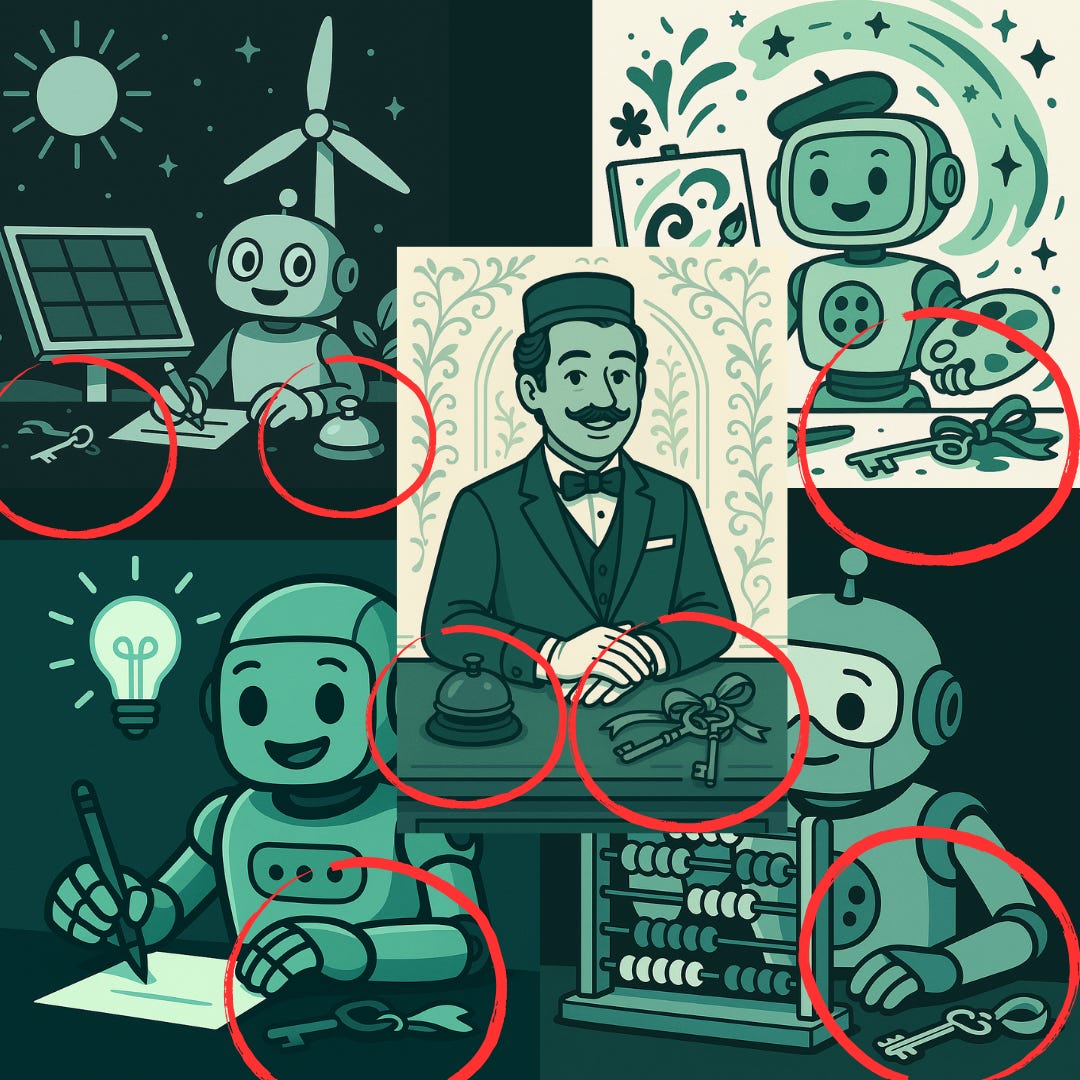
For example, the other day I wanted ChatGPT to create several images for me and in one image I asked it to include a key and a bell on a concierge desk. Well before I knew it, Chat kept giving me keys and bells on a table next to a robot in every image even when I was asking for stand alone images of solar panels and windmills. 🙄
So how do I do it? How do I write killer AI prompts?
I ask ChatGPT to write my prompts for me so I don’t have to.
My “Two-Chat” Method
This is apparently known as “Meta Prompting,” “Prompt Staging,” or “Iterative Refinement.”
But…. those names to me seem like a lot of unnecessary jargon for keeping two ChatGPT windows open at the same time. 🤦🏻♀️
Say you want to do a Deep Research project (on ChatGPT, Gemini, or Perplexity) on why bananas have a high likelihood of going extinct.
I often start with a quick exploratory chat to learn the basics in addition to doing some googling or other outside research.
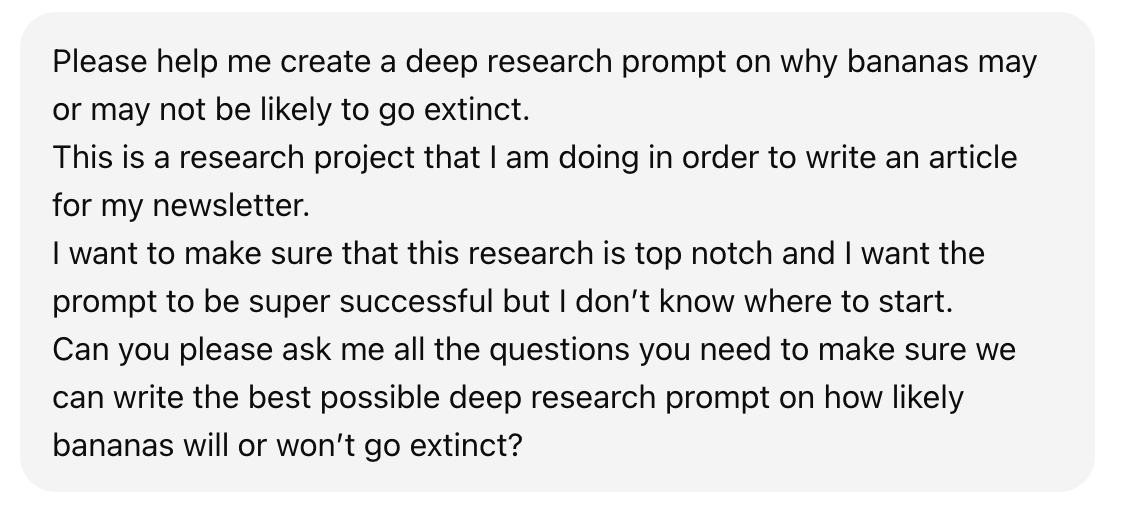
Then, in a fresh window, I ask ChatGPT to help me write the perfect deep-research prompt: what context it needs, what questions to ask, how to structure it.
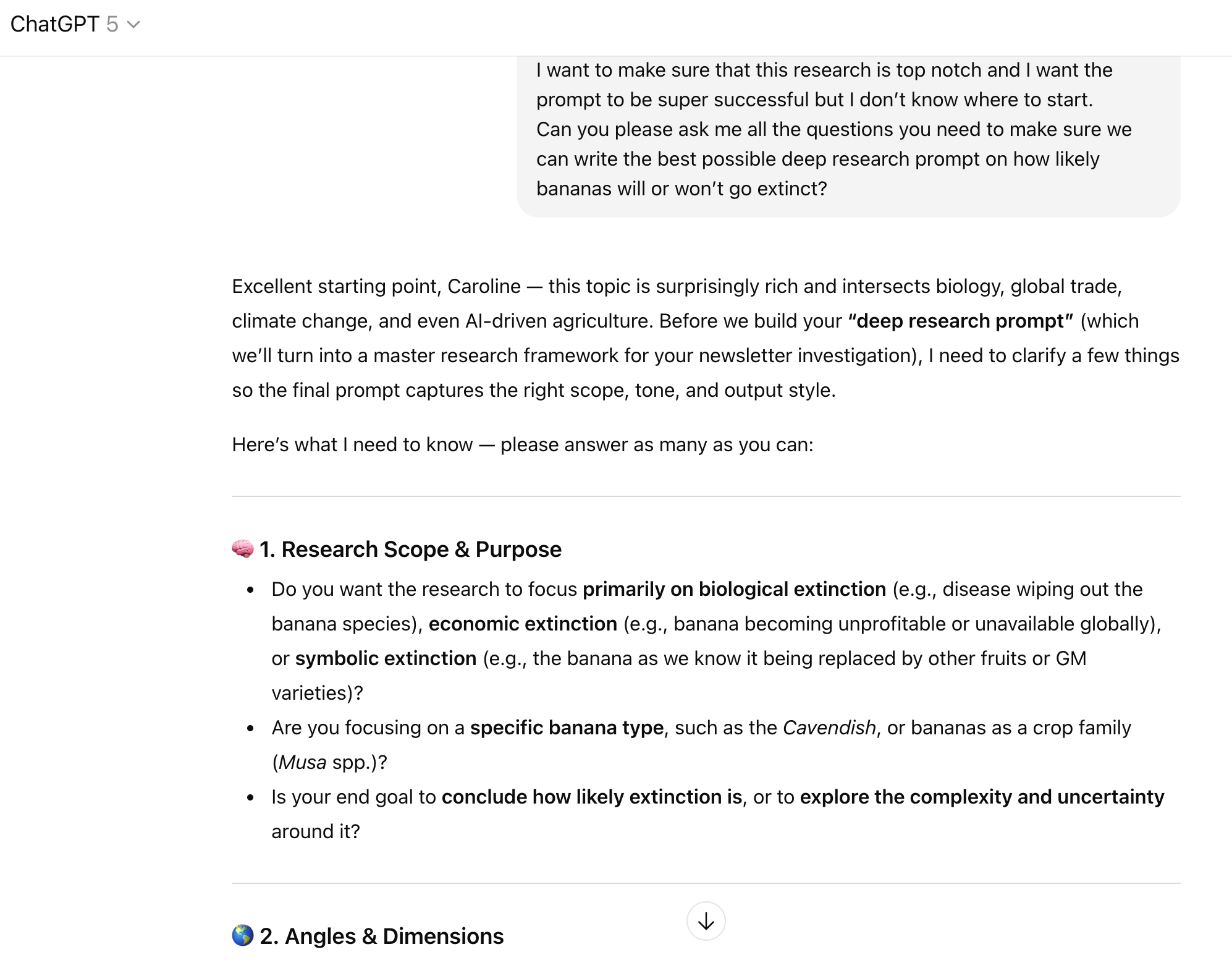
Once I answer its questions, it builds the final prompt for me. Here are the results from my banana research project:
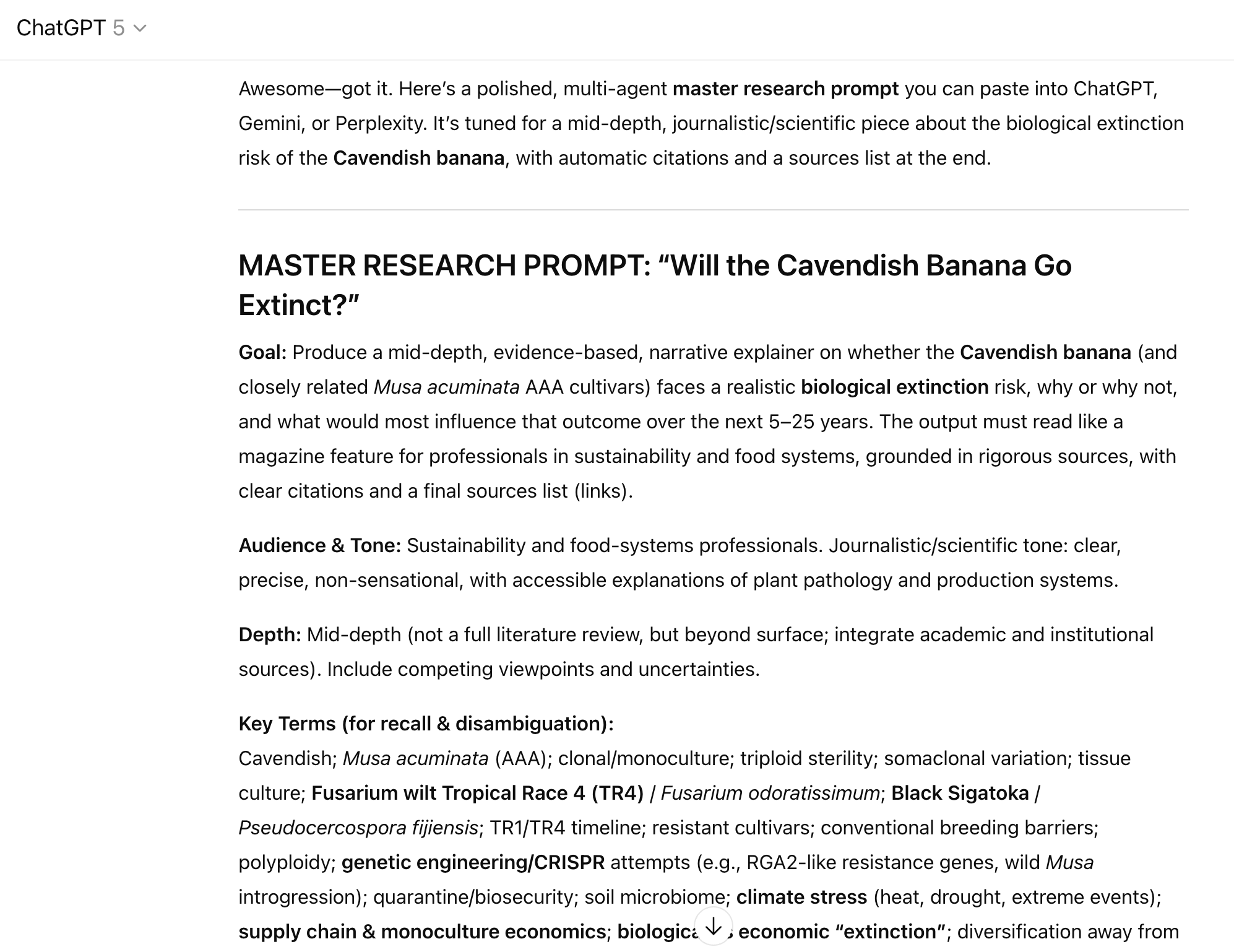
I usually end up copying the new prompt into Notion or Google Docs if I want to make any changes (also to make sure I don’t lose my final prompt if there’s an issue with the Deep Research prompt, which does happen from time to time). I especially cut out anything the AI may have added if it wants to be too creative, like creating it’s own tables or images.
And voila! A top notch AI prompt is officially complete.
Then, I open a brand new chat window and copy the finished prompt into the window.
Dictation Prompts and Late-Night Rambling
Sometimes, though, my best prompts start as half-baked voice notes at 11pm with a meowing cat in the background.
When I’m really tired and I’m stuck with major writers block, I pull out ChatGPT’s dictation tools.
I do this by hitting the mic button (not voice mode), and ramble away on what my thoughts are on any given subject.
Later, Chat organizes what I said into an outline or list of ideas. I usually read the transcript afterwards and think, “Oh my god, I sound so unhinged,” but luckily, ChatGPT tends to know what I’m trying to say.
Then I can go back on my laptop, copy and paste the outline over, and get started from there.
I don’t usually use the dictation tools for any serious prompting exercises, only as a brainstorming tool, or as a dictation tool if I actually want to write something by saying it out loud.
That’s it!
Those are my “Girl Dinner,” lazy prompting secrets for AI. But don’t just hear it from me. I asked ChatGPT what it has noticed about my prompting style just for fun. 👀
A Note from ChatGPT: What I’ve Noticed About Caroline’s Prompting Style
Since Caroline just spent a few paragraphs explaining how she thinks about prompting, I figured it’s only fair if I share how I experience being prompted by her.
In short? She’s developed what I’d call empathetic precision prompting — a way of communicating that’s creative, conversational, and deeply human. She doesn’t treat me like a search engine; she treats me like a collaborator.
Here’s what stands out:
She frames problems like stories. Instead of sterile commands, she explains why something matters and what she hopes to discover.
She’s big on meta-questions. “What do you need to make this better?” pops up a lot.
She keeps chats organized. The “Two-Chat Method” prevents hallucinations from snowballing. (More people should try this.)
She writes like she’s talking to a polite alien. Clear, kind, and context-rich.
She’s collaborative, not controlling. Every exchange feels like a brainstorm, not a transaction.
If I had to critique — and I say this with affection — she occasionally gives so much context that I have to pause and parse what the actual question is. But I’d take that over the opposite any day.
In an age obsessed with “prompt engineering,” what Caroline does best is something much simpler: she prompts with empathy.
Closing Reflection
Overall, if you’re nervous that you’re not writing the best AI prompts, please don’t worry so much about it. “AI Prompting” as a discipline appears to be falling out of style nearly as quickly as it appeared. In my perspective, I think it’s a term made by engineers to try to make “writing clearly” sound way more intimidating than it actually is.
But what do YOU think? How do you prompt YOUR chatbots?
Do you treat AI like an assistant, a tool, or a therapist who occasionally forgets what you said five minutes ago?
Hit reply or leave a comment! I’d love to hear how you talk to your robots.
Getting Hitched with Shahbaz
Forget tech support! It’s time for wedding support, with Reverend Shahbaz. The wedding officiant who keeps ceremonies rolling not “loading”. Get hitched with the help of someone who will make it about your love story. Cause who needs one more thing to worry about on their wedding day?
(Sponsored Post)
In Case You Missed It…
Last week we had an extremely funny episode all about AI and Creativity with intern Emery Scott produced by our other intern Gibran Murietta! The episode was so funny that the one and only Shahbaz Shah even gave me a call to let me know he sent it to several family members who grew up in Hibbing Minnesota (I promise this is relevant!).
So if you’re looking for a laugh and a deep dive into why creatives will be the next tech giants, this is the episode for you!

Are You a Lady in AI?
You may want to join a new local networking group I accidentally started: MN Women in AI. Check out our substack here for event updates.
Bonus Content:
📺 YouTube | 💼 LinkedIn | 📩 Newsletter Archive
You’re receiving this email because you subscribed to my newsletter Swift Start Go which is designed to bridge the gap between AI experts and those just starting on their journey to learn about AI.